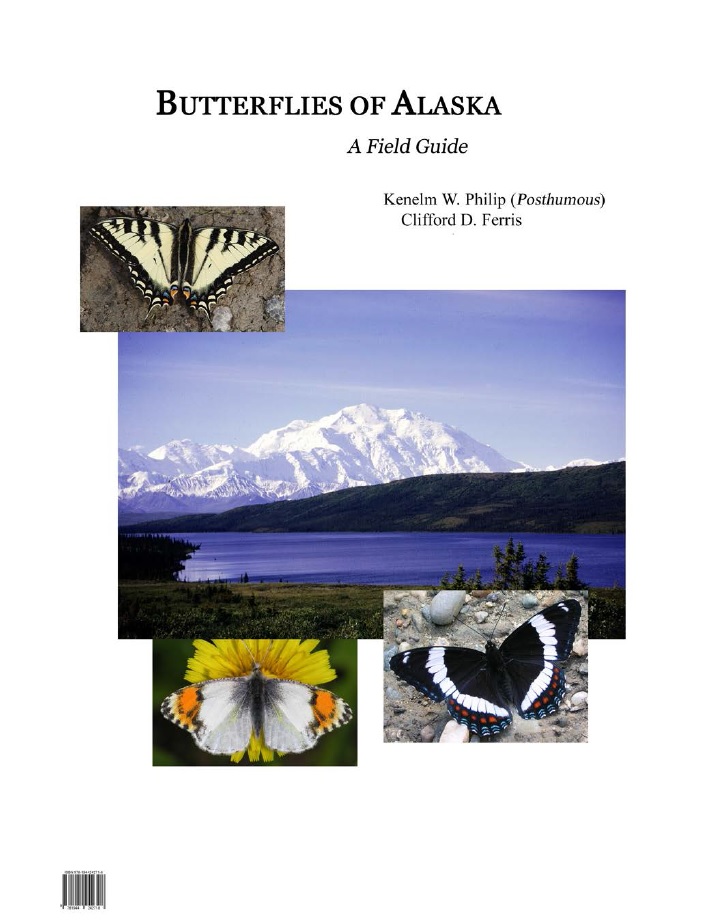
Butterflies of Alaska, A Field Guide will soon be available for purchase. Details are available at the URI below.
http://www.akentsoc.org/documents/field-guide-to-alaska-butterflies
Butterflies of Alaska, A Field Guide will soon be available for purchase. Details are available at the URI below.
http://www.akentsoc.org/documents/field-guide-to-alaska-butterflies

Generalized range map of current distributions of the Papilio machaon species complex in North America.
The article appeared in the journal PLOS ONE on October 30.
URI:
http://journals.plos.org/plosone/article?id=10.1371/journal.pone.0141882
Citation:
Dupuis JR, Sperling FAH (2015) Repeated Reticulate Evolution in North American Papilio machaon Group Swallowtail Butterflies. PLoS ONE 10(10): e0141882. doi:10.1371/journal.pone.0141882
The article appeared in the journal ZooKeys on September 30. See the article at the URI below.
It appears that the signal crayfish, Pacifastacus leniusculus, is now established in Alaska. See the articles below.
Invasive Species Breeding in Buskin River
http://www.kmxt.org/index.php?option=com_content&task=view&id=6769&Itemid=2
Another Crawdaddy Found in Buskin
http://www.kmxt.org/index.php?option=com_content&task=view&id=6580&Itemid=2
Camacho, A.I., R.L. Newell, Z. Crete, B.A. Dorda, A.Casado., and I. Rey. 2015. Northernmost discovery of Bathynellacea (Syncarida: Bathynellidae) with description of a new species of Pacificabathynella from Alaska (USA). Journal of Natural History. http://dx.doi.org/10.1080/00222933.2015.1083621
From the abstract:
A new species of the genus Pacificabathynella Schminke and Noodt, 1988 is described from groundwaters of Alaska (USA). This is the first record of Bathynellacea Chappuis, 1915 from the far north of America.
These were from the Kwethluk River (60.34520N, 161.089146W) on the Yukon Delta National Wildlife Refuge.
Derek Sikes shared this blog and newsletter with me. I encourage you to look at these.
blog:
https://tundraarthropods.wordpress.com/
Network for Arthropods of the Tundra, Newsletter 2, October 2015
https://tundraarthropods.files.wordpress.com/2015/07/neat-news-october-2015-2nd-ed.pdf
Bill Davidson, a U. S. Forest Service Student Trainee for Forest Health Protection this summer managed to capture a few great videos of one of our native horntails. While in Cooper Landing this summer Bill found Urocerus flavicornis in action on spruce logs that were cut as part of a fire wise program. Also known as a wood wasp, U. flavicornis is a wood borer that can typically be found on stressed, dying and dead spruce trees in Alaska. It is also commonly found in association with cut wood and saw logs. Although this insect looks menacing, it is completely harmless to humans.
Emergence: https://www.youtube.com/watch?v=078tCtrfQiU
Oviposition: https://www.youtube.com/watch?v=VYfjFOAQcyo
More information on Urocerus flavicornis and other wood wasps and horn tails can be found in these places:
http://www.fs.usda.gov/Internet/FSE_DOCUMENTS/stelprdb5315942.pdf
http://www.fs.fed.us/foresthealth/technology/pdfs/GuideSiricidWoodwasps.pdf

Global climate models from Germany (green), Canada (red) and USA (black) scaled to the Kenai predict that post-2030 mean summer temperatures will always be above the threshold for spruce bark beetle outbreaks. Observed temperatures are from the Homer airport since 1932. Lower bar graph shows annual beetle-kill for southern Kenai since aerial surveys began in 1971 (US Forest Service). Ed Berg graphic.
The article (URI below) appeared in the Kenai National Wildlife Refuge’s Refuge Notebook series.
The article appeared May 5 in Biodiversity Data Journal.
Pampell R, Sikes D, Pantoja A, Holloway P, Knight C, Ranft R (2015) Bumble Bees (Hymenoptera: Apidae: Bombus spp.) of Interior Alaska: Species Composition, Distribution, Seasonal Biology, and Parasites. Biodiversity Data Journal 3: e5085. doi: 10.3897/BDJ.3.e5085
Topics included new exotic species, mosquitoes, pollinators, carpenter ants, etc.
This is a nicely written and very informative article on the importance of collecting.
https://theconversation.com/why-we-still-collect-butterflies-41485